WHAT LASTS FOREVER? (Revelation 22:3) Everything seems so fragile these days. News gets old in seconds, emails in hours, movies in days, electronic gadgets in weeks, cars in months, and buildings in years. Nothing seems enduring in our world.
We live more and more in a world that is temporary. From the delete button on the email screen to the trash can on our digital cameras—everything seems to be short-lived. All around us we see decay, even on the cosmic level everything is headed towards what physicists call ‘heat death’.
When we get to the end of everything--what is left? In other words, what will last forever?
The Bible ends with the book called Revelation. The last chapter is Revelation 22, and that last chapter ends with only three things left in eternity that really matter: God, Heaven and one more element—servants serving God.
So we need to get a grip on who are God’s servants and how do they serve? All that lasts are God and those who serve Him; that is what God's Word is all about. If we are to someday spend eternity serving God, how are we doing at our current serving?
Have you paused to notice who are those surrounding God’s Throne?
Revelation 22:3 And there shall be no more curse, but the throne of God and of the Lamb shall be in it, and His servants shall serve Him. NKJV
Revelation 22:6, 9 Then he said to me, “These words are faithful and true.” And the Lord God of the holy prophets sent His angel to show His servants the things which must shortly take place. 9 Then he said to me, “See that you do not do that. For I am your fellow servant, and of your brethren the prophets, and of those who keep the words of this book. Worship God.” NKJV
There are almost three thousand biographical portraits in the Bible. In fact, the Bible is the single greatest source of biographical information from antiquity. There are more different individuals from a wider scope of history recorded in God's Word than any other single source in the world.
Most of the lives recorded in the Bible are only mentioned by name, but some are very clearly examined and analyzed by God. Those deeply explained lives give us great reasons to pause and listen to what God may have to say about them. After all He took the time and went to all the effort to capture these portraits for us and then delivered them to us in a forever settled in Heaven book—the Bible.
THE LIFE MOST NOTICED BY GOD
Transcript
Sometimes I think it's great to look at the conclusion, especially as you start a new year. So, let's go to the last book of the Bible, okay, and the last chapter of the last book, the last words of the Bible. Let's look at the conclusion because it's very orienting to our lives to look at where we're going to end up, and what we're going to be doing, and what we're supposed to do forever. And as we're reminded of that, check and see if that's what we're doing now because you'll never be in the future what you're not becoming right now.
And in Revelation 22, I want to show you, when we get to the last chapter of the Bible, what is the ending? The ending is God, Heaven, and one more wonderful reality, verse 3, God's servants serving Him. Look at verse 3 of Revelation 22, and there shall be no more curse, but the throne of God and the Lamb shall be in it—this is describing Heaven, and then here is everything else that matters—and His servants shall serve Him. The bottom line of the conclusion is that Heaven is going to be filled and peopled with God's servants that are serving Him. That's really all that matters.
Keep going down to verse 6, same thing, and he said to me, these words are faithful and true. And the Lord God of the holy prophets sent His angel to show His servants the things which must shortly take place. Why, that's a summary of the whole book of Revelation! It was sent by God to God's servants to show them what's coming so they can get ready and get in sync. Look at verse 9, for he said to me, see that you do not do that. For I am your fellow servant, and of your brethren the prophets, and of those who keep the words of this book. Worship God. And that's the angel. Angel said, hey, I'm just what you are. I am a servant of God. Make sure that you serve God. So, who are God's servants and how do they serve? That should be, as we're looking at the conclusion, and see all that matters is God in Heaven and His servants are there. And that's what we're going to be doing forever in Heaven is serving God. Who are God's servants, and how do they serve? That's what all the other 1,188 chapters of the Bible are all about. If the last one, the 1,189th, says that Heaven is God and His servants then we should want to examine the rest.

There are almost 3,000 biographies portrayed in the Bible. In other words, people's lives described. In fact, the Bible is the single greatest source of biographical information from antiquity. The Bible is the greatest compendium of the historic drama depictions of people anywhere. There are more people described in the Bible than any other book from the ancient world. It is the source. It has more individuals from a wider scope of history recorded than any other single source in the world. However, most of the people that are mentioned in the Bible, there are 2,900 plus, almost 3,000 individuals recorded in the Bible. Most of them are only briefly described, some of them as brief as just their name on a roster of genealogies, but some of the 3,000 are very clearly examined and analyzed by God. In other words, their lives aren't just lived. God gives us His divine commentary, His analysis of their life. These deeply explained lives give us great reasons to pause and especially this morning, to pause and say, if what matters is serving God and if what lasts are God's servants, then who does God say is a great servant, and how can we please Him like they did? We need to listen to what God has to say about his special servants. After all, God took the time, and God went to all the effort to capture these portraits for us. And then He delivers all those portraits in this book, the once and for all settled in Heaven Word of God. So, God not only energized these people to be His servants, but He captures their lives, records and analyzes them, and puts them into a book, and places it into our hands. So, we should pay attention.
So, whose life is considered most important to God? Of all the people next to Jesus Christ, whose life is so important to God, He writes more about them than anybody else? Whose life is the most recorded, the most analyzed, the most detailed, and most examined life next to Jesus Christ in the whole Bible? Let's go to Acts 13, and we'll meet them. Okay? Acts 13, now back up. We're backing through the Bible. You're in the end, and back up to just past the beginning of the New Testament, the fifth book, the book of Acts chapter 13. Because when God chose to write more about one single person, the most written about single person in the whole history of the world, as far as God's concerned in the Bible, it's the young man that we're going to find in Acts 13 and verse 22, and this is right in the middle. We're picking up in the middle of the Apostle Paul's sermon, and he's preaching along, and in verse 22, he gives us a divinely ordained little biographical sketch. And this is what he says, Acts 13:22, and when He had removed him—that's King Saul—He raised up for them—and here's the most recorded person in the Bible—David—there he is—as king, to whom also—now look at this—He gave testimony. God stands up, as it were, in court and testifies. He said, I'd like to, your Honor. When I was little, we used to always watch Perry Mason, and all the more I look back on life, every Perry Mason show is exactly the same. Mystery, Perry Mason got it, it seems bad, and all of a sudden at the end, at the last minute someone runs through the back door, and they're the prime witness, and this case is solved. I could have written that script. Life is a little more complicated than that nowadays, but look at God's testimony. When God comes in and testifies in a life, He gave testimony and said, (here's God's intense analysis of this servant named David) I have found David the son of Jesse—listen to this—a man after My own heart, who will do all My will. God-heartedness, after God's heart, means doing His will. When someone does your will, they serve you. David was God-hearted, doing all of God's will because he was God's servant.
So, this morning, David's spiritual secret. That's what I'm calling this examination this morning. What was David's spiritual secret? Why is he the most talked about man in the Bible? Why did God say He's after My own heart? His God-heartedness is most evidenced in what it says right here: he did all My will. Now, what does someone look like that's God-hearted? It's a whole new way of looking at life. Listen to what Paul continues. Look at verse 36, same chapter. Now, I have to turn the page here, Acts 13:36. Because what will a God-hearted, doing-the-will-of-God person do in their lives? What will their life pan out to be? What is the bottom line? Paul continues, and he says this, verse 36, for when David had served God's purpose in his own generation. Now that, I'm reading, just then I reverted from the New King James to the NIV because the NIV captures a little word that's in there that's a very big word, but it's just that word served. When David had served God's purposes for his own generation. What was the sum of David's life? God put him on Earth, and God's eyes searched to and fro throughout the Earth and found David whose heart was completely toward Him. And David was so God-hearted that David served God's purposes in his generation.
Now, you and I are in this generation. Some of us are well toward the end of this generation. Some of you are just starting out in this generation, but you're in a generation. You're in a period of time. You're going to live on this planet. You know what matters to God? Are you going to be His servant in the generation He puts you in? It's real simple. You know why it's so important? Because that's what we're going to be doing forever. We're going to be serving Him forever, and so we ought to be vitally concerned that we're doing it now because you won't be a servant in the future if you're not one now is what He's trying to get across to us.
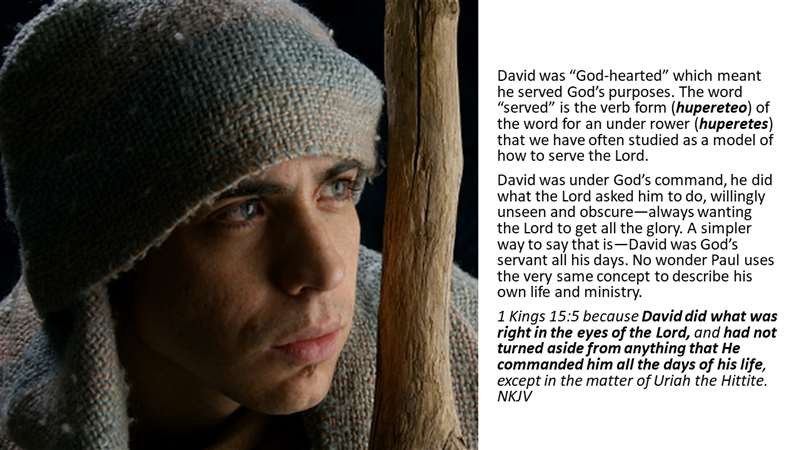
David was God-hearted, which means he served God's purposes, verse 36 says. The word served is the verb form. The word is, in Greek, hypereteo, of that very, very beautiful word, under-rower, that I've talked to you a lot about. Hyperetes, the lowest deck rower on a trireme, a Roman galley slave ship. We've often studied the model of how to serve the Lord from that passage. Paul says, if you want to know what I'm like, I am an under-rower. I'm a bondservant on the bottom deck for Christ. So, David was under God's command. He was this hypereteo, this servant, and he looked at life as being going through life totally under God's command. God says, go. He went. God says, do this. He did it. God says, say that. He said it. God says, worship Me. He did it. He was God's servant.
It's interesting here in Acts, in the new covenant after the cross, it's so interesting how David's described. It says that he did all My will, verse 22. He served My purpose. Doesn't say anything else. Doesn't say, except for Bathsheba, except for the numbering of the people, except for being a man of blood. Isn't it interesting how God looks at his life after He has got him home? After He's got him in His presence. He sees him with all the sins stripped away, and what rises up, the cream of his life was his heart's desire to serve God. David was under God's command. David did what the Lord asked him to do. David willingly was unseen and obscure. David was always wanting the Lord to get all the glory. A simpler way to say that is David was God's servant all of his days. It's no wonder that Paul uses the very same concept in 1 Corinthians 4:1 to describe his own life and ministry.
Now let's turn to the Old Testament, 1 Kings, okay. Genesis, Exodus, Leviticus, Numbers, Deuteronomy, Joshua, Judges, Ruth, 1 and 2 Samuel, 1 Kings. There it is. It's in the first third, or quarter of the Bible, 1 Kings 15. And we're backing up through the Bible, and we're going to end up a little before this, so keep going with us, 1 Kings 15 and verse 5. I love this. Another summary, another God distillation of a life, okay. 1 Kings 15 verse 5. Listen to this: because David did what was right in the eyes of the LORD—doesn't stop there—and had not turned aside from anything that He commanded him all the days of his life. Wow! David, verse 5 says, David, summarized by God, it says, did what was right in the eyes of the LORD and David had not turned aside from anything he was commanded him all the days of his life. What a good servant. Wow! Can you imagine God saying that? We hear that little well done, good and faithful servant that we all often say that's what we want to hear when we get to Heaven from God, is to say, well done, good and faithful servant. Here's Him saying it. And so, the most talked about man in the Bible, there are more than 141 chapters devoted to the life of David. And that's why the rest of verse 5 is in there, except in the matter of Uriah, the Hittite. Now that's an interesting way of putting it. I thought the problem was with Bathsheba. I thought it was David's adultery that God would point out. But God, and we'll examine this later, God really was saying that David always did His will, except in the matter of Uriah the Hittite. The comforting thing about that is David was imperfect, and he still served God all of his days with all of his heart. He still fulfilled God's purposes even though he failed in a huge way. David is such a great example for us. There are more chapters, 141 to be exact, devoted to the life of David than any other person in all the Bible next to God Himself. That is a profound truth.
I was just speaking this week to a whole big group of college kids, and I just had a blast, and started acting like a college kid and probably that's why I don't feel very good today. I got worn out trying to act half my age, but I was talking to them about this, the biggest challenge. I was supposed to challenge them to get away from all the worldly media and get into the Word of God. And I told them, I said, one of the greatest things you can do is the beginning of the new year, you can start reading through the Bible and looking for something. I said, one of the things, I read through the Bible one time, I read every word of the Bible, and I looked for everybody God mentions in the Bible, 2,938 people. And then I found out who He talked about the most, and I made long charts, and lists, and number one, 141 chapters of the Bible chronicle the life of David. That's a huge amount!
We know more about David's words, more about David's thoughts, more about David's fears, more about David's strengths and weaknesses than anyone else who's ever lived. We also know all about that from God Himself, from His perspective. And that's not all, we also know one very important thing for sure. It's God Himself who tells us David was His servant. David didn't go around wearing a big badge saying, God's servant. Now, I don't think that would be bad, but we know David was God's servant not because David told us, not because other people testified to it, and we're going to see this morning they do. We know it because God says, mark that man. He did My will with all of his heart, all of his days. He was My servant. He did my will. David was God's man. God says his heart was after God and for God. David was serving God as a servant of the LORD for his whole life.
And so, David, the most described man in the Bible, was described for one reason. God has given him to us as our prime Old Testament example of what the life of one of God's servants looks like. I would say Paul in the New Testament is the most clearly chronicled life of a New Testament example. But isn't it fascinating that both of these men, in the final analysis in Acts 13 and 1 Corinthians 4 are described by the same word, they are the biggest and the lowliest servants possible. Paul said, I'm a bondservant in the lowest rank. I am a hyperetes, an under-rower. And God says, so was David. So, the biggest Old Testament and biblical example of servanthood and the biggest New Testament biblical example of servanthood come together in the same place. He that is greatest, as Jesus said, let him be the greatest servant of all. He didn't come to be served but to serve like the Son of Man. That's what Jesus came for. That's what we should want. David is the most described man in the Bible for a reason: God made him our prime Old Testament example of the life of God's servants.
This morning, I'd like for you to study God's Word and see what I call David's spiritual secret. Let's start this great biography in 1 Samuel. Now, back up a little bit more, then we won't back up anymore, 1 Samuel 16. So, it's 1 and 2 Samuel, 1 Kings, so just go back one whole book and part of another to chapter 16 of 1 Samuel. And we're going to read the first 13 verses, 1 Samuel 16. Let's stand together and let's read a great biography divinely penned by the Author of all things, God Himself, as He introduces us to David in these first 13 verses of 1 Samuel 16.
Now the LORD said to Samuel, how long will you mourn for Saul, seeing I have rejected him from reigning over Israel? Fill your horn with oil and go; I'm sending you to Jesse the Bethlehemite. For I have provided for Myself a king among his sons. That's like the great search, the great talent search. Samuel's going out. And that's all God said. He says, among those sons, and he didn't even have any idea how many there were, I provided for Myself a king. So, that's the setting.
So, Samuel said, how can I go? If Saul hears that, he'll kill me. And the LORD said, take a heifer with you, and say, I've come to sacrifice to the LORD. Verse 3, then invite Jesse to the sacrifice, and I will show you what you shall do; and you shall anoint for Me the one I name to you. Again, no name, no indication, Samuel's just operating blindly here with the LORD's help and leadership. So, Samuel did what the LORD said. That's a good sign of a servant. Verse 4, and went to Bethlehem. And the elders of the town trembled at his coming, and said, do you come peaceably? He was afraid of Saul; they were afraid of him, interesting time period. And he said, peaceably; I have come to sacrifice to the LORD. Sanctify yourselves. Sanctify yourselves, so if you're going to come before the LORD, sanctify yourselves, and I hope that's what you did in preparation for this morning. Most important part about this morning is what you did last night until you got up this morning and what you did before you got here because God wants sanctified, set apart people to come before Him, always has. The Old and New Testament are very, very much coherent in that. Come with me to the sacrifice, middle of verse 5, then he consecrated Jesse and his sons, and invited them to the sacrifice. They obviously weren't ready, so he got them ready, and that's what happens sometimes, we have to do that too.
Verse 6, and so it was when they came, they looked at Eliab and he said, surely the LORD's anointed is before Him! But the LORD said to Samuel, do not look at his appearance or at his physical stature, because I have refused him. For the LORD does not see as man sees; for man looks at the outward appearance, but the LORD looks at the heart. So, God is seeing past bigness and everything else, and He's looking at the heart. So, Jesse called Abinadab and made him pass before Samuel. And he said, neither has the LORD chosen this one. Then Jesse made Shammah pass. And he said, neither has the LORD chosen this one. And Jesse made seven of his sons pass before Samuel. And Samuel said to Jesse. By the way, seven's a complete set, and Samuel was very Hebrew-minded, very Jewish. And he went, oh, complete set, seven. Ooh, there, what are we going to do now? I thought we were looking for a king. And Samuel said to Jesse, the LORD has not chosen these. Can you imagine? I just, I have this divine imagination, just looking at all this stuff that God says, and I imagine all this stuff. Can you imagine? That was all there were. Jesse brought in all his kids. He ran them by one at a time, and they're all standing there smiling. Reminds me a little bit of the Cinderella shoe thing. They're all hoping to fit into this mold, and none of them did. And then look at this, and Samuel said to Jesse, are all the young men here? Then he said, there remains yet the youngest. And here they all are. They're up at this big meeting in front of the biggest dignitary of the day. Can you imagine Jesse's red face? Samuel says, I asked for all of your sons. Are they all here? God told me one of them is going to be king, and none of these are king. What's the connection here? And Jesse went, oh, over there, way out in the distance that little shrimp, that little good for nothing, who cares about him, never invite him to the family meetings. You see him over there? See that's what's going on. Over there, and he said, he is keeping the sheep.
And Samuel said to Jesse, send and bring him. For we will not sit down till he comes here. And you think you're never going to sit down, so I'll keep reading a little faster! We will not sit down until he comes here. Verse 12, they sent and brought him. Now he was ruddy. Was that, would you like, hey, Ruddy! How are you doing? These biblical words are so cute. Probably had red hair. It's very interesting what the Hebrew scholars do with this, but he's just this ruddy, bright-eyed, and good-looking. And the LORD said, arise, anoint him; for this is the one! Verse 13, and Samuel took the horn of oil and anointed him in the midst of his brothers. Oh, the rejects. God who looks at the heart let them see the one they didn't like, the one they criticized, the one they constantly tried to discourage, the one that they belittled and picked on all the time. Watch out who you pick on! God might pick them and anoint them in your presence. And the Spirit, at the end of verse 13, of the LORD came upon David from that day forward. And Samuel arose and went to Ramah.
Let's bow. Father in Heaven, oh, we love Your Word. It is so refreshing to read it, to hear it, to see it with our minds, but I pray we would lay hold of it with our wills this morning. And if the greatest thing in all the world is serving You, and if You said that the greatest is not the one that's served the most, but the one that is the greatest servant, and if You, Lord Jesus, told us that You came not to be served, but to serve and to give Your very life. And when we look at the conclusion of the Bible, we find that all that matters is God and those that are around God. And those that are around God, they are Your servants. I pray that every one of us would be stirred to the depths of our beings this morning to want to be Your servant. May that be our heart's cry in wherever generation of life we are—beginning, middle, end—may we with all our hearts desire to serve You. In the name of Jesus we pray, amen.
You may be seated. As you're seated, what is it in a person's life and what do they look like when they have committed themselves to be God's servants? And that's why the most written about man in the Bible is written about. Because we can, now that we've got the big intro from God, God picked him out of the crowd and said, I'm looking at his heart. And when you look at the heart, which no one can see but God, you ask yourself, what was it He saw? What kind of man? What kind of a boy? What kind of a person does God see such great things about? What do they look like? How can I be that way? See, that's the kind of questions I ask. I'm always muttering out loud, and talking, and thinking, and writing stuff down. Because I'm always asking, okay, Lord, why is that in the Bible? Why do You, what is it You want me to see? And so, what does this person look like that's committed to being God's servant? God wants to explain that to us, so let's take it apart.
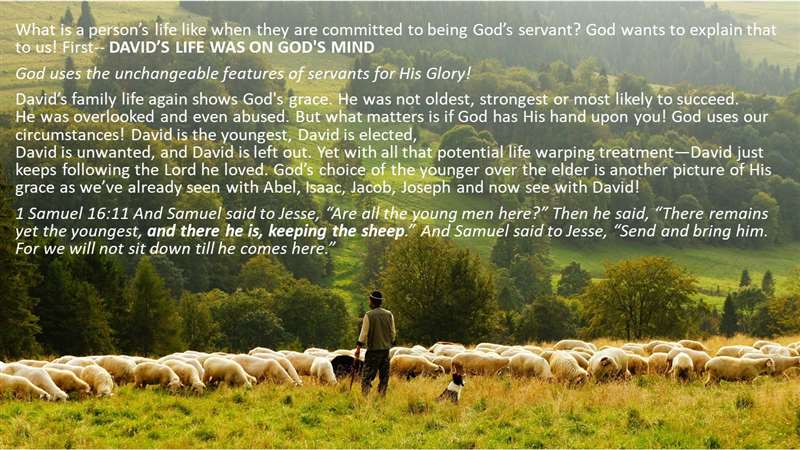
First of all, the first 10 verses. The first thing we'll see that is the characteristic of one of God's servants, is that if you're God's servant, number one, God's servants, like David, David was on God's mind. Listen to this. God uses the unchangeable features of His servants for His glory. What couldn't David pick? He didn't pick what number he was in the rank of sons. He was last. He didn't pick that. In fact, he didn't even pick that family. He didn't pick that dad. He didn't pick those brothers and sisters. He didn't pick that town to live in. Because he lived in that town, he didn't pick his profession. He had to be a shepherd. In fact, no one else wanted to do it, and they made him do it. He didn't pick that. He didn't pick his ruddy appearance. He didn't pick his good looks or bad looks or height. He was on God's mind. God designed him just for what He wanted him to do. What's amazing is I really believe David was little. Little! Why? Because he's an exact contrast to Saul, who was big. King Saul was head and shoulders. I'm not talking about the shampoo! He was height, shoulder high, this much of him was higher than everybody else. Everybody's head came up to his shoulder in the whole nation. That's what it says in the Bible. He was head and shoulders above everyone else in Israel. This guy was a man's man. He would've been the perfect choice, except his heart was a dwarf heart. And David was not big. In fact, he was a very young person. Some of the commentators believed that when he was anointed, he could have been 10 or 12 years old. When he does Goliath in, he could have been a very young teenager, 13, 14, we don't know, but he was young. He was little. He was on God's mind, and God uses the unchangeable features of servants for His glory. David's family life shows God's grace. He was not the oldest. He was not the strongest. He was not the most likely to succeed. He was overlooked. He was even abused. But what matters is if God has His hand on you. God uses our circumstances. David is the youngest. David is the neglected one. David is unwanted. David is left out, yet with all that potential life-warping treatment.
And a lot of people, their life stops right there. I am going to say something real positive, but a lot of people, their life stops right there, and they decide they're going to let all the neglect, and abuse, and oversight, and problems that they have that they can't change. They're going to let that warp them, and the rest of their life, they're going to be a victim of being left. The most repeated experience when they take adults and put them on the couch and try and probe around and find out why their life is warped, you know what the most repeated thing is? That they were left when they were little at the mall or somewhere and forgotten, and that's ruined their life and the rest of their life, they feel worthless because someone left them.
David wasn't forgotten. He was made to go out there. It's worse. You want to really get warped? Be rejected. He wasn't just neglected, he was rejected, but he didn't let that warp his life. David just kept following the LORD that he loved. God's choice of the younger over the elders is just another picture of His grace. Have you ever thought about that? Why did Samuel look at Eliab first? Because God, the firstborn. Remember, they got the bigger inheritance, they got the rights, they got the all the, and then everything else was split up among the rest. But God doesn't choose the one that everyone else thinks. Remember, Abel was the second-born. Isaac was the second-born. Jacob was the second-born. Joseph was way past second-born. And now David, look back at verse 11, Samuel said to Jesse, are all the young men here? And then he said, there remains yet the youngest. There he is over there; he is keeping the sheep. David was on God's mind. He designed this to be a picture to us. You don't have to be in the prime spot. You don't have to be the oldest, or the brightest, or the strongest, or the most likely to succeed. All you have to have is what God sees, and that's a heart for Him. That's the first thing about God's servants.
The second one is God uses the disciplined lives of His servants for His glory. Look at verse 12. David was handsome and hardworking. When Samuel sent for David, they called him from where? Where was David? It says in verse 12, so they sent and brought him in. You know what? Dad hadn't even been paying attention to where David was, Jesse, dad of David. When Samuel came on the spot and says, where's your other son? Jesse said, doing what I told him to do right over there. How did he know that? Because David was disciplined. David had been given an assignment to watch the sheep. He didn't forget to watch the sheep. He didn't forget it was his turn. He didn't forget it was his day. He didn't forget that was his job. There's something about him that's so simple: David did what he was supposed to do. His dad knew he would be right where he was supposed to be watching the flock.
By the way, what did David do while he was watching the flock? Keep your finger here and turn back over to Psalm 132, okay, right in the middle of your Bible. Don't lose your place but go right to the middle. You should hit somewhere in the Psalms, and go to the one hundred thirty-second Psalm, because if you remember, Psalm 132 is David's meditation from when he was a shepherd boy. We covered that many weeks ago, and that was the first time I said to you and started thinking about David's spiritual secret. And the hundred thirty-second is actually David's spiritual secret, his journal, if you will, his diary, his blog, or whatever you want to call it, where he wrote down. History tells us this is what he wrote when he ascended to be king. When David, as Psalm 78 says, was taken from tending sheep to become the shepherd of the people of God, he seems to have written this hundred thirty-second Psalm as his bio, or whatever, and God inspired him to write it.
LORD, remember David and all of his afflictions—and David went through a lot—how he swore to the LORD, and vowed to the Mighty One of Jacob. Now here are the resolves of a youngster that became the greatest person most described in the Bible among humans. Okay? Here's his resolve; surely, I will not go into the chamber of my house or go up to the comfort of my bed; I will not give sleep to my eyes or slumber to my eyelids, until I find a place for the LORD. That's a nice resolve. Have you ever made that one? I might add, I will not park my body and vegetate in front of the television set. I will not invest endless hours watching athletic events. I will not play mindless, drivel games of fantasy when I've got the real and living, eternal, infinite God in front of me, and ignore Him to do all that. David just had sheep and work, but he says, I will not rest, I will not sleep, I will not close my eyes until I have found a place for the LORD. You know what? This is a holy habit. That's why David was all hung up with making the Temple because he loved making places for God in his life. That's his first resolve: God's going to have a place in my life. That's what a servant wants. A servant's not concerned about themself. They're concerned about who they serve. He said, I'm going to make a place for You, God. That's my holy habit. God ahead of comfort. The comfort of my bed, verse 3. He had this holy habit of making time for God.
Verse 6 continues, behold, we heard of it in Ephrathah. What's that? That's where he lived. That's how we know this is talking about when he was a shepherd boy. O thou Bethlehem Ephrathah. He says, we heard about it in Ephrathah; we found it in the fields of the woods. Let us go to His Tabernacle, let us worship at His footstool. As a shepherd boy, he longed for God personally. This is almost probably his words from when he used to talk to his brothers and say, I wonder how long before Dad takes us up for the next feast. I can't wait to go to the tent. And the brothers went, what's wrong with you? Man, we want to go see the pretty girls by the well. What do you want to go to some tent and see some God? That's so hokey. Things haven't changed. David was different. They thought he was weird because his resolve was, he wouldn't even sleep at night till he found a place for the LORD. He wouldn't lay down. He's out there looking up at the stars and talking to God and praying and all that. He says, I want to worship.
Verse 7, let us go into His Tabernacle; let us worship at His footstool. He longed for God. Arise, O LORD, to Your resting place, to the ark of your strength. Let Your priests be clothed with righteousness. Wow. He really thought a lot about purity. And let your priests be clothed. He was concerned about coming before God, and about purity, and about being clothed with holiness and righteousness. Let your saints shout for joy. Probably it was pretty dead around the Tabernacle in David's time. Nobody engaged in worship, and he wanted to shout for joy. He loved the LORD. Verse 10, for Your servant David's sake. That's how he looked at himself, servant of the LORD, David. The LORD has sworn in truth to David; verse 11, He'll not turn away. I'll set upon your throne the fruit of your body. If your sons will keep My covenant and My testimony which I shall teach them, and on goes the rest of this Psalm about his coronation.
Back to 1 Samuel 16, that was David's resolves. That was David's holy habit. That was what David had as a young person. That's what God saw in his heart. David was disciplined. David had thought much in the endless hours during those monotonous times with the dumb, fearful, and easily wandering sheep. He had thought about seeking God ahead of personal comfort. He made time for the LORD. He was a good shepherd boy. He longed for God. He pondered the priority of personal purity. He was strengthened by righteous living. Wow.
But look at the end of verse 12 of 1 Samuel 16. Here's another element. David's life was on God's mind. David's life was disciplined. You know what else? David's life was available for God to use. See, Psalm 132 was David's testimony. He said, David Thy servant. Long before Samuel came calling, long before the ark, the flask of oil was filled and the old prophet started trudging toward Bethlehem to anoint David. Long before that, David had settled in his heart, I'm Your servant. When you say to God you're His servant, you know what you're saying? I'm available. David's life was available to God. Do you know why a lot of people will not accomplish much for eternity? They're not available! They're not available! For the eyes of the LORD run to and fro throughout the Earth, looking for someone who will give their attention to God, and so many aren't available. David was available. God uses the available lives of servants for His glory. David was chosen by God because God is always on the lookout for servants.
The end of verse 12, he was ruddy, had bright eyes, he was good-looking. And the LORD said, arise, [anoint] him; for this is the one! He's the only one in this family that's available to Me. All the rest of them are quarrelsome, selfish, self-absorbed, thinking of their own stuff. They didn't even invite David out of the field. They didn't even care about David. David was just do-your-job and stay-out-of-sight kind of kid to them. God says, that's the one I want. What is someone after God's heart? They're God's servants. They're in harmony with God. Their burden was what burdens God. When David was sitting out in that field, he was just going, oh, I wish I could be in the tent worshiping God. Oh, I hope the priests are clothed with righteousness. When I was there, if I ever get there again, I'm going to shout worship to God. Boy, the LORD hears those kind of thoughts, those kind of resolves, that kind of a heart beating for Him. David was burdened with what burdened God. He was obeying all that he knew mattered to God. In other words, his heart was all God's.
I wonder this morning, is your heart for God? Does He have all of it? Is it all His? Have you, as a young person or a not so young person, said what David said? I'm Your servant. I'm available. I can't change what, the unchangeable parts of my life, I can't change what family You put me in, who my parents are, what I look like, what size I am. But I can make a choice. I'm Your servant. And God says, that's all that matters because I'm watching over the rest, and I'm going to use all that for My glory.
2 Chronicles, you can just write this down, but I'm going to turn there because I really believe this is what happened to David. 2 Chronicles 16:9 says this, for the eyes of the LORD run to and fro throughout the whole Earth. That means that God's eyes are cruising around Tulsa right now. More than that, God's eyes are cruising around this room right now, and God's looking not at the outward, not at who is meticulous, not who has fastidiously gotten ready and just wearing the perfect outfit today. God's looking through the outfit at the heart. And it says, the eyes of the LORD are running to and fro throughout the whole Earth, because God wants to show Himself strong on behalf of those whose heart is loyal to Him. Wow.
So, back to 1 Samuel Chapter 16, David was on God's mind because David was loyal. That's what the LORD's looking for. A servant is loyal. Because Jesus said, no servant can serve what two masters for either you love the one hate the other, or you hold to the one and despise the other. You can't serve two masters. Jesus said David was loyal, didn't have two masters, himself and God, or his agenda and God's. He was loyal to one Master. And the eyes of the LORD will show Himself strong. God will find them and show Himself. God Himself gets on the side of those whose heart is loyal toward God. David was on God's mind. He was loyal. And as later God reveals in Psalm 78, David was a man of integrity. See, that's what's so neat about the Bible, and that's why there's so many chapters about David. Let me read to you what Psalm 78 ends with. It says in Psalm 78—a Psalm about Israel and David being their king—He also chose David His servant. That's Psalm 78 verse 70, and took him from the sheepfolds; from following the ewes that had young He brought him, to shepherd Jacob His people, Israel His inheritance. Verse 72, so he shepherded them according to the integrity of his heart and guided them by the skillfulness of his hands. Do you know why God picked David? Because he was on His mind, because he was loyal, and because he was a man of integrity. And what we'll see is that David is the same. He didn't have his public church way he acted persona and have a different one when he was out with the boys, out with the guys, out at work or whatever. He had integrity. There was a real consistency.
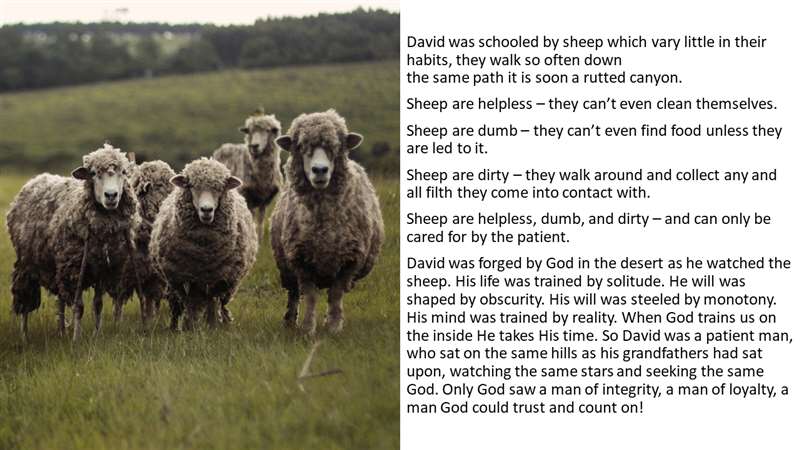
David had been schooled by sheep, which vary little in their habits. It says in 1 Samuel chapter 16, when they called for him, they brought him from being with the sheep in verse 11, and he came directly from the sheep. The school of the sheep, and sheep are a great school. They walk down the same path so long it becomes a rutted canyon. Sheep are helpless. They can't even clean themselves. They are dumb. They can't even find food unless they are led to it. Sheep are also dirty. They walk around and collect any and all filth they come into contact with. Sheep are helpless, dumb, and dirty, and can only be cared for by the patient. David was forged by God in the desert as he watched those sheep. Instead of hating every minute of it and saying, this is a dead-end job, and I don't like it here, and it's such a waste, I'm too talented for this low-end job; it was actually the refining, the proving grounds. It was the school that David had to graduate from to be the shepherd of Israel, to be God's king. If David would've just said, man, I'm just going to blow this place and go hang out at the ark of the covenant, the Temple, the Tabernacle, he would've missed his lessons. He wouldn't have made it. God forged him in the desert as he watched the sheep. His life was trained by solitude. His will was shaped by obscurity. His life was steeled by monotony. His mind was trained by the reality of being out there and having to care for those sheep and not get distracted. When God trains us on the inside, He usually takes His time. So, David had to go through this training.
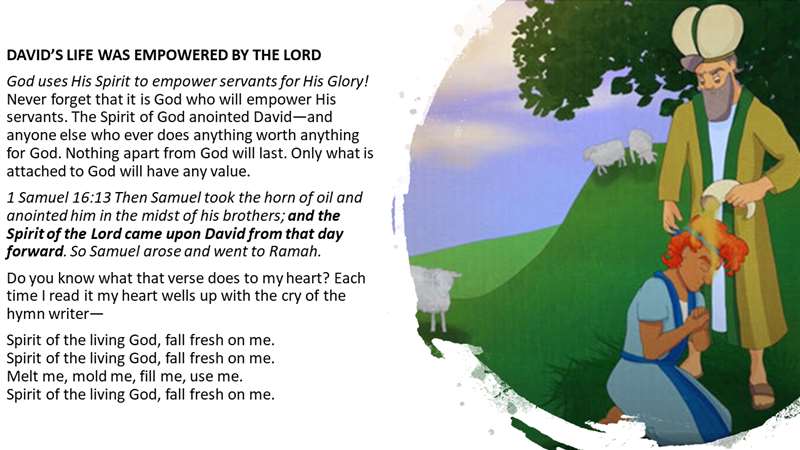
Look at verse 13 of 1 Samuel 16, and we're trekking through these, and I don't think we'll get through all of them because this is just a very full chapter. The next thing we see about David God's servant is his life was empowered by the LORD. God uses His Spirit to empower servants for His glory. Never forget that it's God who empowers His servants. Verse 13, and Samuel took the horn of oil and anointed him—David—in the midst of his brothers—and look at this—and the Spirit of the LORD came upon David from that day on, from that day forward. The Spirit of the LORD came on him. This is such a picture of the new covenant. In the old covenant, the Spirit of God was not resident in every believer. He was watching over them, but there was not an internal gifting, not an internal wonderful anointing of the Spirit that we have now. It came, and it went. Now, some of the super wonderful ones like Daniel and Ezra, it seems like the Spirit of God, and David and others, was continuously on them, like on us. They were precursors to us in the new covenant but never forget it's God who empowers His servants. The Spirit of God anointed David and anyone else, whoever does anything worth anything for God.
Nothing apart from God will last. Only what's attached to God will have any value. Do you realize that? Only what's attached to God. Look at the end, Revelation 22, what ends up lasting forever? God and those who were His servants, and they're in a place in His presence called Heaven. Only what's attached to God will last forever, that's good. Of course, the eternal, endless destruction that Isaiah 66 seems to imply that we get to see from Heaven at some time is going to be present, but nothing that is good that lasts forever is unattached to God.
You know what? Verse 13, look at 1 Samuel 16:13. Once more it says, and the spirit of the LORD came upon David from that day forward. When I read that verse, you know what it does to my heart? Every time I read it, my heart wells up, and I think always of the same thing. If David is the most talked about person in the Bible, if David is described by God as the servant that did all of His will, if David is described the man that fulfilled what God wanted him to do with his life, and if that isn't the ultimate servant, I don't know what is. And if Jesus said, the greatest thing you want to be in the world is be a servant. And that all happened because of verse 13, and the Spirit of the LORD came on David. Do you know what I think of? I think of these words, Spirit of the living God, what? Fall afresh on me. Melt me where I'm cold. Mold me instead of being conformed to the image of the world, into the image of Christ. Use me like David. Spirit of the living God, fall afresh on me.
Did you know that God empowers His servants? Did you know that nothing that matters can be accomplished without the power of God? Did you know that David was available? Because David said, Your eyes are running around to and fro; here I am. I'm Your servant. I'm available. I'm on Your mind. You picked who I am. I'm not going to fight against it. I just want You to know I'm available. Whatever You want me to do, I want to serve You. Is that where you've come in your Christian life? You ought to come there soon because you'll never be in the future what you're not becoming right now. And if you know already in the future, you're going to be God's servant, don't you want to tell Him today, I'm Your servant? I'm available. I want to do Your will.
I'll read these words again. Spirit of the living God, fall afresh on me. Spirit of the living God, fall afresh on me. Melt me, mold me, fill me, use me. Spirit of the living God, fall afresh on me.

I pray that from our hearts, O Lord, you would hear that whisper of our wills saying, I'm Your servant. I'm available. Whether in obscurity or before people's sight, all that matters to me is serving You. You're more important than my plans, my agenda, my goals, my time. I'm Yours, Lord. Use me as Your servant. May we be Your good and faithful servants. Thanks for telling us about the one that did all of Your will all of his days. May that be what we are. In the name of Jesus, we have asked that, and all of God's servants said, amen.